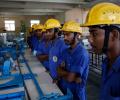
Unincorporated enterprises in the manufacturing sector lost nearly 1.8 million establishments and shed 5.4 million jobs between July 2015-June 2016 and October 2022-September 2023, an analysis of the fact sheet on 'Annual Survey of Unincorporated Sector Enterprises (ASUSE)' and the comparable 73rd round survey in 2015-16 by the National Statistical Office (NSO) showed. An estimated 17.82 million unincorporated enterprises operated in the manufacturing sector in October 2022-September 2023, nearly 9.3 per cent down from 19.7 million unincorporated enterprises in July 2015- June 2016.

The number of fresh formal jobs generated in a month increased to a seven-month high in April, signalling a recovery in the formal labour market in the country, according to the latest monthly payroll data released by the Employees' Provident Fund Organisation (EPFO) on Thursday. In April, the number of new monthly subscribers under the Employees' Provident Fund (EPF) sequentially increased by 18.77 per cent to 887,438 from 747,146 in March.

'Efforts are on to make the data readily available so that it proves useful for policymakers.'

After adding 11.7 million workers in the October 2022-September 2023 period from the pandemic lows in April 2021-March 2022, total workers employed in the vast informal sector in India - at 109.6 million - still remains below the pre-pandemic period.

'The scheme excludes tractors, light commercial vehicles, and medium and heavy commercial vehicles.'

Locals have witnessed real estate prices skyrocket from a historic low of Rs 6,000 per square yard (in 2020) during Jagan Mohan Reddy's regime to around Rs 40,000 to Rs 50,000 per square yard after elections.

'The government has put in a lot of effort to provide infrastructure for the industry.'

'Wherever the government has provided incentives for the purchase of two-wheelers, three-wheelers, cars, buses, and trucks, it gets a push for most of these alternate fuels. '

Both Chandrababu Naidu and Pawan Kalyan assured voters that they would bring jobs and industrial development to the state. Their alliance batted for a welfare-plus-development model.

>Bihar (18 days) has the most number of heatwave days in 2023, followed by Andhra Pradesh (15 days), Odisha (15 days), Jharkhand (13 days), West Bengal (8 days) and Tamil Nadu (6 days).

Chandrababu Naidu's victory comes barely eight months after his political career seemingly crashed in September 2023 when the YSRCP government arrested him in an alleged corruption case.

This will also help test the effectiveness of preventing the entry of Nipah in target cells.
'The government has put in a lot of effort to provide infrastructure for the industry.'

The cricketing extravaganza became a business opportunity for everyone, from five-star hotels to cafes to street vendors across the country on Sunday.

Following in Apple's footsteps, Alphabet - Google's parent company - is in advanced talks with Foxconn to manufacture Pixel smartphones in Tamil Nadu, an industrial state which will also double up as drone-manufacturing hub for the US tech giant soon. According to a state government release, officials from Google will soon visit Chennai to meet Tamil Nadu Chief Minister MK Stalin to hold discussion on manufacturing of Google Pixel near Chennai.

The share of women employed in regular salaried jobs in urban India hit a fresh low in the January-March quarter (Q4) of 2023-24 (FY24). In the same period, the share of women engaged in self-employment went up. An analysis of the latest quarterly Periodic Labour Force Survey (PLFS) data showed the share of women in regular wage work among all employed women stood at 52.3 per cent in Q4FY24, down from 53 per cent in the previous quarter.

'In April, we saw a 10 per cent growth in our own volumes.'

'It is a fiercely fought battle, like our fiery chillies in Guntur.'

As the triangular political contest in Telangana intensifies, many believe that for the regional major BRS, it is a battle for survival after being routed in the assembly polls held late last year. What is haunting the party this time is the scams, the 10-year anti-incumbency factor, and family dominance in the party.

The share of the Hindu population declined by 7.8% to 78.06%.
In contrast, the share of the Muslim and Christian populations increased by 43.15% to 14.09%, and by 5.4% to 2.36%.
